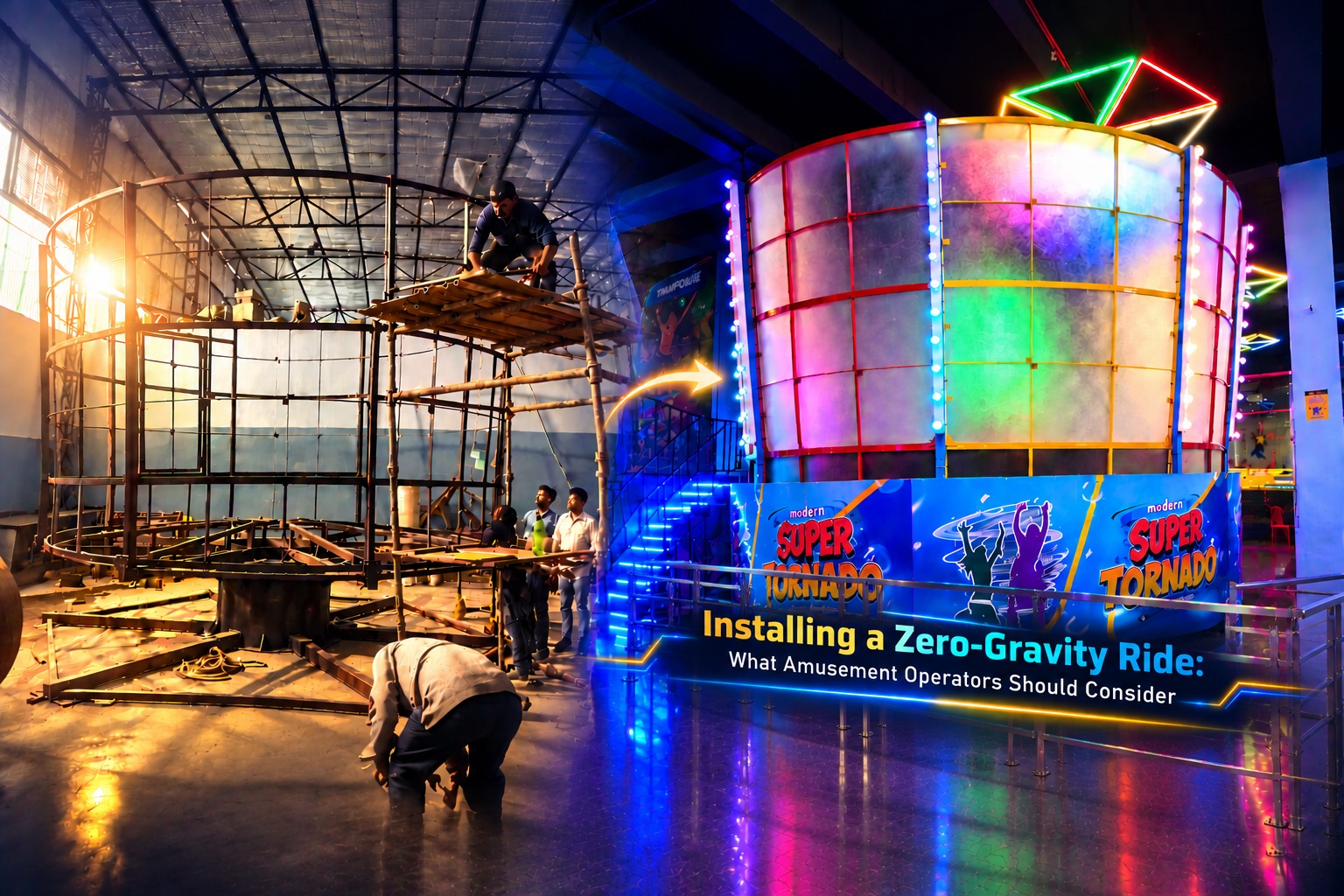
Available space, installation requirements, expected footfall, operating procedures, maintenance arrangements and technical support all influence whether an attraction will perform effectively within a particular venue.
These considerations become especially relevant when introducing a high-thrill spinning attraction such as a zero-gravity ride.
Modern XD's Super Tornado offers an example of an Indian-manufactured amusement ride designed to create brief sensations of weightlessness. For businesses evaluating such an investment, understanding the operational requirements is as important as understanding the experience itself.
Understanding the Role of a High-Thrill Attraction
The first question an amusement operator should consider is not necessarily which ride creates the greatest excitement, but which attraction is most appropriate for the intended audience.
A family entertainment centre serving young children and accompanying adults will have different requirements from a destination amusement park catering to teenagers and thrill-seeking visitors.
Attractions must therefore be selected in relation to the venue's broader entertainment offering.
For instance, arcade games encourage repeat participation through skill, competition and rewards, while mechanical rides generally provide a more defined physical experience. Both can contribute to a balanced amusement environment, although their operating requirements and visitor expectations differ.
A high-thrill attraction such as Super Tornado may be considered by operators seeking to introduce a stronger physical amusement component.
However, the decision should take into account the intended age group, applicable rider restrictions, projected demand and the suitability of the surrounding entertainment environment.
Evaluating Space and Installation Requirements
One of the most important considerations in amusement ride procurement is the relationship between the equipment and the space available for its installation.
A ride's physical dimensions represent only one part of the planning process. Operators must also account for passenger access, queuing arrangements, loading and unloading areas, maintenance access, circulation routes and any required operational clearances.
These details can become particularly important in indoor amusement centres, where several activities may need to function within a shared commercial floor.
An attraction that appears suitable when assessed solely by its dimensions may create operational difficulties if sufficient surrounding space has not been allocated. For this reason, manufacturers and venue planners should evaluate the proposed layout before finalising equipment selection.
Structural and electrical requirements, site conditions and applicable permissions also need to be established according to the specific ride configuration.
Modern XD manufactures Super Tornado in Gwalior and provides installation and commissioning services. Its product offering includes customisation options, allowing prospective operators to discuss the attraction in relation to their venue's requirements.
Why Visitor Throughput Matters
The commercial performance of an amusement attraction is influenced partly by the number of visitors it can accommodate within a given operating period.
This is generally referred to as visitor throughput. When evaluating a ride, operators need to consider the seating capacity, duration of each cycle, time required for boarding and disembarking, and the intervals necessary for operational checks.
The relationship between these factors determines the practical number of passengers who can experience the attraction over time.
A ride with strong visual appeal may attract considerable attention, but the operator must also understand how queues will be managed during peak hours. Excessive waiting periods can affect the wider visitor experience, particularly in entertainment centres where customers expect to participate in several activities during a single visit.
Conversely, efficient passenger movement can help the attraction fit more comfortably into the venue's overall operations. Throughput should therefore be evaluated using the specific manufacturer's technical information rather than relying on general assumptions about the ride category.
Maintenance and Operational Reliability
Mechanical amusement attractions operate through repeated cycles involving moving components, electrical systems and structural assemblies. Their long-term performance depends on the quality of engineering as well as the inspection and maintenance procedures followed throughout their operating life.
For amusement businesses, even a relatively short period of unexpected downtime can affect revenue, visitor satisfaction and staffing arrangements. Maintenance planning should consequently begin during the procurement stage. Operators should establish which inspections are required, what routine servicing involves, how replacement parts will be obtained and what technical assistance will be available after installation.
The availability of trained personnel is another important consideration. Ride operators must understand the approved operating procedures, loading requirements, emergency arrangements and applicable passenger restrictions. Maintenance teams must also have access to appropriate documentation and technical guidance.
Modern XD’s Super Tornado offering includes installation, testing, commissioning, spare parts and after-sales service. Such arrangements are relevant when comparing suppliers because an amusement ride remains a long-term operating responsibility after its initial installation.
The Value of Manufacturing and Technical Support in India
For Indian amusement businesses, the origin of the equipment can influence procurement and service arrangements.
International suppliers may offer access to established ride technologies, although overseas purchasing can involve shipping expenses, import-related costs, international coordination and additional considerations surrounding replacement parts.
Domestic manufacturing can offer a different procurement structure. Working with an Indian manufacturer may simplify communication during the design and installation stages, while potentially improving access to technical teams and locally available components.
However, these advantages depend on the supplier's actual manufacturing capabilities, service infrastructure and contractual commitments.
Modern XD manufactures Super Tornado at its facility in Gwalior, Madhya Pradesh. The company also develops other amusement equipment, including drop towers, motion simulators and interactive entertainment systems. For prospective buyers, the relevance of this manufacturing arrangement lies in the opportunity to discuss product specifications, customisation, commissioning and future support directly with the supplier.
Considering the Investment Beyond the Purchase Price
A ride's acquisition cost is an important part of financial planning, but it does not represent the complete cost of operating an attraction. Businesses must also consider site preparation, installation, electrical requirements, staffing, maintenance, insurance where applicable and ongoing operating expenses.
The expected revenue contribution should be evaluated against realistic assumptions about visitor demand and ride utilisation. Footfall alone is not sufficient to establish commercial viability. Operators need to understand how frequently visitors are likely to purchase tickets, how the attraction fits into existing pricing arrangements and whether its operating capacity can support projected demand.
A proper financial assessment should therefore distinguish between estimated revenue, operating costs and the period required to recover the initial investment.
For Super Tornado, the final purchase price depends on the selected configuration and customisation requirements. Prospective buyers should request project-specific technical and commercial information before developing financial projections.
Choosing an Attraction for Long-Term Operations
The amusement industry is influenced by changing visitor expectations, but the fundamentals of operating a commercial attraction remain consistent. A ride must suit its audience, fit the available infrastructure, function reliably and remain practical to operate throughout its intended service life.
Super Tornado demonstrates how an attraction centred on physical motion can contribute to a contemporary amusement offering. Its zero-gravity positioning provides a recognisable identity, while its commercial suitability must be determined through the same detailed evaluation required for any substantial amusement equipment investment.
For operators planning a new entertainment destination or expanding an existing facility, the most useful approach is to assess visitor experience and operational feasibility together. After all, an attraction's value is ultimately determined by how effectively it continues to function within the business.
Frequently Asked Questions
1. What should operators consider before purchasing a zero-gravity ride?
Operators should assess their available space, target audience, installation requirements, passenger throughput, technical specifications, maintenance arrangements and overall investment budget.
2. Can Super Tornado be customised for different amusement venues?
Yes. Modern XD offers customisation options for theming, colours, lighting and branding. The final configuration should be discussed with the manufacturer according to the venue's requirements.
3. Where is the Super Tornado amusement ride manufactured?
Super Tornado is manufactured by Modern XD at its facility in Gwalior, Madhya Pradesh, India. The company provides installation, commissioning and after-sales support.
By Modern Group · 15 Oct 2026
← Back to Newsroom